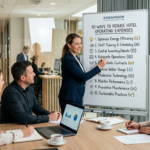

Running a successful hotel requires much more than providing comfortable rooms and friendly service. Behind every great guest experience is a well-organized operation where employees, departments, technology, finances, and daily processes work together efficiently.
This is where hotel operations management becomes essential. Effective hotel operations management helps hotel owners and managers control costs, improve staff productivity, maintain service standards, increase guest satisfaction, and create better profitability.
In today’s competitive hospitality industry, hotel operations management must continuously improve their operations. Rising costs, changing guest expectations, online competition, staffing challenges, and changing booking patterns make efficient management more important than ever.
A strong operational strategy can help a hotel reduce unnecessary expenses while maintaining service quality. It can also create consistent procedures that make everyday work easier for employees and more satisfying for guests.
In this guide, we will explore practical hotel operations management strategies that can help improve efficiency, guest experience, and long-term profitability.
What Is Hotel Operations Management?
Hotel operations management refers to the planning, coordination, supervision, and improvement of the daily activities required to run a hotel successfully.
It covers multiple departments and functions, including:
- Front office
- Housekeeping
- Food and beverage
- Kitchen operations
- Maintenance
- Reservations
- Sales and marketing
- Human resources
- Finance
- Purchasing
- Guest services
- Security
Each department has its own responsibilities, but all departments must work together.
For example, when a guest checks out, the front office communicates with housekeeping so the room can be cleaned and prepared for the next arrival. If communication is delayed, the room may remain unavailable and affect the hotel’s ability to sell it.
Good hotel operations management creates clear communication, defined responsibilities, standard procedures, and measurable performance.
Korahsson’s hospitality services include hotel operations management, post-opening operations, staff training, financial planning, audits, housekeeping solutions, restaurant management, and consultancy, making operational efficiency an important part of its overall hospitality approach.
Why Is Hotel Operations Management Important?
Efficient hotel operations directly influence both guest satisfaction and profitability.
A hotel may have excellent rooms and a good location, but inefficient internal processes can increase expenses and create poor guest experiences.
Effective operations management can help hotels:
- Reduce unnecessary operating costs
- Improve employee productivity
- Maintain consistent service standards
- Improve communication between departments
- Reduce operational errors
- Improve room turnaround time
- Increase guest satisfaction
- Control inventory
- Improve revenue performance
- Strengthen the hotel’s reputation
The goal is not simply to make employees work faster. The goal is to create better systems that allow employees to work more effectively.
When processes are clearly defined, employees know what is expected, managers can identify problems more quickly, and guests receive a more consistent experience.
10 Hotel Operations Management Strategies to Improve Efficiency & Profit
1. Create Clear Standard Operating Procedures
Standard Operating Procedures, commonly known as SOPs, are one of the most important foundations of efficient hotel operations.
SOPs provide employees with clear instructions for completing specific tasks and maintaining service standards.
Hotels can create SOPs for:
- Guest check-in
- Guest check-out
- Room cleaning
- Room inspection
- Complaint handling
- Food preparation
- Inventory management
- Maintenance requests
- Emergency procedures
- Lost and found
- Reservation handling
Without proper SOPs, employees may perform the same task differently.
This can create inconsistency and confusion.
Well-designed SOPs make daily operations more predictable and help new employees understand their responsibilities faster.
However, SOPs should not simply exist in a manual. Employees need to be trained on them and managers should regularly check whether they are being followed.
2. Improve Communication Between Departments
Poor communication is one of the common causes of operational problems in hotels.
A guest may request something from the front office, but if the information does not reach housekeeping or another relevant department, the guest experience can suffer.
Hotels should establish clear communication systems between departments.
Daily briefings, shift handovers, digital communication systems, task-management tools, and departmental meetings can help employees stay informed.
For example, the front office should have updated information about:
- Available rooms
- Room status
- VIP arrivals
- Early check-ins
- Late check-outs
- Guest requests
- Maintenance issues
- Special occasions
Better communication reduces mistakes and allows employees to respond to guest needs more quickly.
3. Focus on Staff Training and Productivity
Employees are one of the most important assets in the hospitality industry.
Even the best hotel systems will not work effectively without properly trained employees.
Hotel staff should understand both their technical responsibilities and the hotel’s service standards.
Training can cover:
- Guest communication
- Hospitality etiquette
- Complaint handling
- Department-specific procedures
- Safety
- Hygiene
- Technology
- Upselling
- Time management
- Team communication
Training should be continuous rather than limited to an employee’s first few days.
Regular training helps employees stay updated and improves consistency.
Korahsson specifically provides SOP-based staff training designed to improve service quality, communication, and operational efficiency across hotel departments.
4. Improve Housekeeping Efficiency
Housekeeping plays a major role in hotel operations.
Clean and well-maintained rooms directly influence guest satisfaction and online reviews.
An efficient housekeeping operation should focus on:
- Room cleaning standards
- Room inspection
- Cleaning schedules
- Linen management
- Inventory control
- Maintenance reporting
- Room turnaround time
- Communication with front office
Managers should monitor how quickly rooms are cleaned and released for sale without compromising cleanliness.
Room inspection procedures are particularly important.
A room should not simply be marked as clean. It should meet defined quality standards before being released to the front office.
Better housekeeping coordination can improve room availability and reduce guest complaints.
5. Control Hotel Operating Costs
Increasing revenue is important, but controlling unnecessary costs is equally important.
Hotels have many expenses, including:
- Employee costs
- Utilities
- Food supplies
- Housekeeping supplies
- Maintenance
- Marketing
- Technology
- Laundry
- Purchasing
- Administrative expenses
Hotel managers should regularly review operating expenses and identify areas where resources are being wasted.
For example, better inventory management can reduce unnecessary purchasing. Preventive maintenance can reduce expensive equipment breakdowns. Proper staff scheduling can help avoid unnecessary labor costs.
However, cost control should never mean reducing essential service quality.
Cutting housekeeping standards or reducing important guest services may save money temporarily but can damage guest satisfaction and future revenue.
The objective should be smart cost management, not simply cost cutting.
6. Use Data to Make Better Decisions
Modern hotel operations should be supported by accurate data.
Managers can monitor important performance indicators such as:
- Occupancy rate
- Average Daily Rate (ADR)
- RevPAR
- Total revenue
- Departmental revenue
- Labor costs
- Food costs
- Guest complaints
- Online reviews
- Cancellation rates
- Booking sources
- Repeat guests
Regularly reviewing these metrics helps management understand what is working and where improvements are required.
For example, if occupancy is increasing but profitability is not improving, management may need to investigate room pricing, operating costs, commissions, or departmental expenses.
Data allows managers to move from assumptions to informed decisions.
7. Improve the Guest Experience
Operational efficiency should never come at the expense of guest satisfaction.
The best hotel operations balance efficiency with hospitality.
A guest’s experience can be affected by many operational details, including:
- Reservation accuracy
- Check-in speed
- Room cleanliness
- Staff communication
- Response time
- Food quality
- Complaint resolution
- Check-out experience
Managers should regularly review the complete guest journey.
Ask:
Where can the guest experience become easier, faster, or more comfortable?
Even small improvements can make a meaningful difference.
For example, better pre-arrival communication can help guests understand check-in procedures and available services before they arrive.
8. Improve Inventory and Purchasing Management
Poor inventory management can create unnecessary expenses.
Hotels purchase and manage a wide range of products, including:
- Food ingredients
- Beverages
- Cleaning products
- Linen
- Guest amenities
- Office supplies
- Maintenance materials
Hotels should establish proper purchasing procedures and stock controls.
Important practices include:
- Maintaining minimum and maximum stock levels
- Monitoring consumption
- Checking supplier pricing
- Reducing waste
- Conducting regular inventory checks
- Avoiding unnecessary purchases
- Monitoring product quality
For food and beverage operations, inventory control becomes particularly important because waste and spoilage can directly affect profitability.
Effective purchasing ensures that the hotel has what it needs without unnecessarily tying up money in excess stock.
9. Use Technology to Simplify Operations
Technology can help hotels manage many daily activities more efficiently.
Depending on the property’s size and requirements, hotels can use technology for:
- Property management
- Reservations
- Housekeeping
- Guest communication
- Inventory
- Accounting
- Staff scheduling
- Customer relationship management
- Reporting
- Revenue management
Technology should not be introduced simply because it is popular.
The right technology should solve a specific operational problem.
Before implementing a system, hotel management should consider:
Will this technology save time, reduce errors, improve service, or provide better information?
If the answer is yes, it may be a worthwhile investment.
10. Conduct Regular Operational Audits
Hotel operations should be reviewed regularly.
An operational audit can identify problems that management may not notice during everyday activities.
An audit can examine:
- SOP compliance
- Staff performance
- Guest service
- Housekeeping standards
- Food and beverage operations
- Inventory
- Purchasing
- Financial controls
- Maintenance
- Safety
- Department communication
The purpose of an audit is not simply to find mistakes.
It is to identify opportunities for improvement.
Korahsson also offers audit services focused on operational and performance reviews and improving efficiency through standard procedures.
How Hotel Operations Management Improves Profitability
Hotel profitability depends on more than room sales.
A profitable hotel needs to manage revenue and expenses together.
For example, increasing occupancy may appear positive, but if rooms are sold at very low rates while operating expenses remain high, profitability may not improve significantly.
Effective hotel operations management helps create a balance between:
Revenue + Cost Control + Service Quality + Operational Efficiency
Better operations can reduce waste, improve employee productivity, increase room availability, improve guest satisfaction, and support stronger revenue performance.
A well-managed hotel can also identify additional revenue opportunities through food and beverage, events, upgrades, packages, meetings, and other services.
The key is to make sure every department contributes to the hotel’s overall business objectives.
The Role of Hotel Management in Operational Success
Hotel managers play an important role in connecting strategy with daily execution.
A strong hotel manager should understand:
- Operations
- Finance
- Staff management
- Guest experience
- Revenue
- Marketing
- Quality standards
- Problem-solving
Managers should regularly communicate with department heads and review performance.
They should also create a culture where employees feel responsible for service quality.
Good leadership means more than solving problems after they occur.
It means identifying potential problems before they affect guests.
How to Measure Hotel Operational Efficiency
Hotels should establish measurable performance indicators.
Some useful KPIs include:
Occupancy Rate
Measures the percentage of available rooms that are sold.
Average Daily Rate
Shows the average revenue generated per occupied room.
RevPAR
Helps evaluate room revenue performance by considering both occupancy and room rates.
Guest Satisfaction
Shows how guests perceive the hotel’s service and experience.
Employee Productivity
Helps management understand how effectively staff resources are being used.
Room Turnaround Time
Measures how efficiently housekeeping prepares rooms for new guests.
Operating Cost Percentage
Helps identify whether expenses are being managed effectively.
Online Review Performance
Provides insight into guest perceptions and service quality.
Regular KPI monitoring helps hotel managers identify trends and take corrective action.
When Should a Hotel Consider Professional Operations Consulting?
Professional hotel consulting can be useful when management needs an independent assessment or specialized expertise.
A hotel may benefit from operational consulting when:
- Profitability is declining
- Operating costs are increasing
- Guest complaints are increasing
- Staff performance is inconsistent
- Occupancy is below expectations
- Departments are not communicating effectively
- SOPs are missing or outdated
- A new hotel is preparing to open
- The property needs operational restructuring
- Management wants to improve long-term performance
Professional consultants can evaluate existing processes and provide practical recommendations based on the hotel’s specific situation.
Korahsson provides hospitality consultancy covering areas such as hotel operations, staff training, marketing and branding, front-office setup, financial planning, and pre-opening support.
Why Continuous Improvement Matters in Hotel Operations
Hotel operations should never remain static.
Guest expectations change. Technology changes. Competition changes. Costs change. Market conditions change.
Therefore, hotels need to continuously review their operations and improve their systems.
A useful improvement cycle is:
Analyze → Plan → Implement → Measure → Improve
First, identify the problem.
Next, develop a practical solution.
Then implement the change and measure the results.
If the strategy works, continue improving it. If it does not produce the expected results, identify what needs to change.
This approach creates a culture of continuous improvement.
Conclusion
Hotel operations management is the foundation of an efficient, profitable, and guest-focused hotel.
From creating strong SOPs and improving communication to training employees, controlling costs, managing inventory, using technology, monitoring KPIs, and conducting regular operational audits, every operational improvement can contribute to better hotel performance.
The objective is not simply to reduce costs or increase bookings. Successful hotel operations require a balanced approach that protects service quality while improving efficiency and profitability.
For hotel owners and managers, the most effective strategy is to regularly evaluate how every department operates and identify opportunities for improvement.
With the right systems, trained employees, effective leadership, and data-driven decision-making, hotels can create smoother operations, stronger guest experiences, and sustainable business growth.
A professional hospitality consultant can also provide an independent perspective and help turn operational challenges into practical opportunities for improvement.
For a hospitality business looking to improve efficiency, strengthen operations, and build long-term profitability, investing in effective hotel operations management can be one of the most valuable steps toward sustainable growth.
Frequently Asked Questions
What is hotel operations management?
Hotel operations management is the process of managing and improving the daily activities of a hotel, including front office, housekeeping, food and beverage, maintenance, staff, guest services, finance, and other departments.
Why is hotel operations management important?
It helps hotels improve efficiency, control unnecessary costs, maintain service standards, improve guest satisfaction, increase productivity, and support profitability.
How can hotels improve operational efficiency?
Hotels can improve efficiency by implementing SOPs, training employees, improving department communication, monitoring KPIs, controlling inventory, using suitable technology, and conducting regular operational audits.
How does hotel operations management improve profitability?
Efficient operations can reduce waste and unnecessary expenses while improving productivity, room availability, guest satisfaction, and revenue opportunities.
What are important hotel operations KPIs?
Important KPIs include occupancy rate, ADR, RevPAR, revenue, operating costs, labor costs, guest satisfaction, room turnaround time, online reviews, and booking performance.
When should a hotel hire a consultant?
A hotel may consider professional consulting when it faces operational challenges, declining profitability, high costs, staffing issues, low occupancy, poor guest satisfaction, or needs support with pre-opening or operational restructuring.