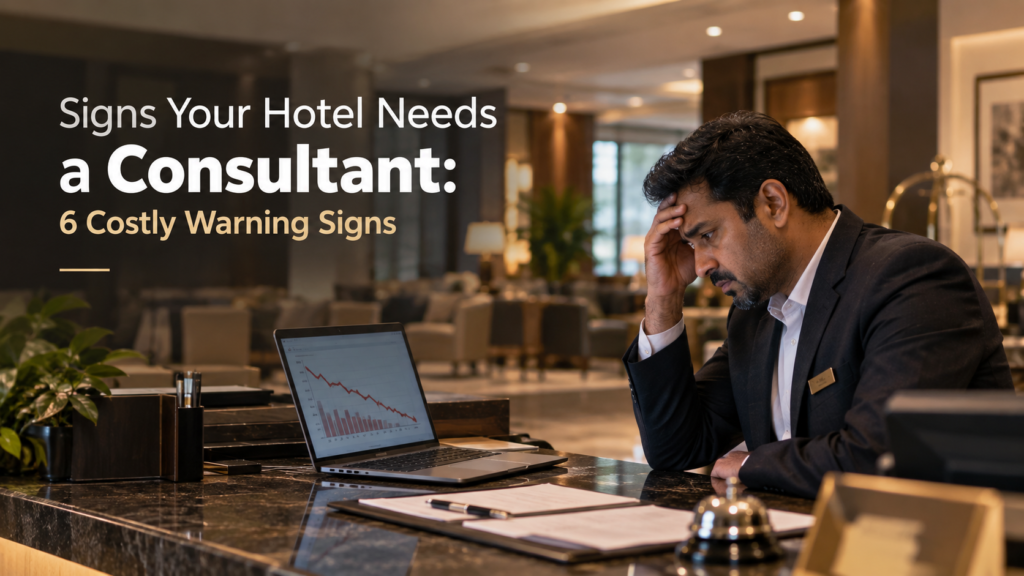
Most hotel owners don’t pick up the phone to call a consultant when things are going well. They call when the bank balance is already shrinking, the best staff have resigned, and the online reviews have turned sour. By then, fixing the problem takes longer and costs more than it should have.
The frustrating part is that the signs your hotel needs a consultant almost always appear months earlier. They show up quietly, in places that are easy to explain away. A slow season. A difficult employee. A couple of unlucky reviews. Each one looks harmless on its own. Together, they form a pattern.
This guide walks through six of the clearest signs your hotel needs a consultant, a quick self-check you can do this week, what happens if you ignore the signals, and what a consultant actually does once you decide to act. If you own or manage an independent hotel or resort, read it as a checklist of the signs your hotel needs a consultant, with your own property in mind.
Why hotel owners miss the signs your hotel needs a consultant
There’s a simple reason owners miss problems in their own hotel: they’re too close to it. You see the property every day, so gradual decline feels normal. A room that’s a little less clean than last year, a front desk that’s a little slower, a restaurant that’s a little emptier. None of it feels urgent.
There’s also the pressure of running the place. When you’re handling guests, staff, suppliers and payments at the same time, stepping back to look at the whole operation feels like a luxury. So problems get patched instead of solved, and the same issues come back every few months in a new form.
An outside view breaks that cycle. That’s the real value of a consultant, and it’s why knowing the signs your hotel needs a consultant matters more than any single tool or technique.
Sign 1: Your occupancy is sliding while nearby hotels stay busy
Every hotel has slow periods. Monsoon, exam season, a local festival that moves dates. If the whole town is quiet, that’s seasonality, and there’s not much to fix.
The warning sign is when your occupancy drops and comparable hotels nearby stay busy. Walk past them on a weekday evening. Check how many rooms they show on booking platforms. If they’re selling and you’re not, the problem is inside your property.
The cause could be pricing that doesn’t match your quality, poor photos and descriptions online, weak reviews, or a website that doesn’t turn visitors into bookings. Often it’s a mix of all four. Many owners spend a whole year blaming “the market” before they look honestly at their own operation. The sooner you compare yourself with the hotels that are doing well, the sooner you can see the gap. It is often the very first of the signs your hotel needs a consultant.
Sign 2: The same complaint keeps appearing in guest reviews
One guest complaining about a slow check-in is an accident. Ten guests complaining about it over three months is a system failure.
Read your last fifty reviews slowly, not just the star rating. Look for repeated words: dirty washrooms, cold food, rude reception, noisy rooms, no hot water, long wait at breakfast. When the same complaint appears again and again, there’s a process missing, not just a person who had a bad day.
This matters for another reason too. Reviews influence where new guests choose to book, and they feed into how Google and booking platforms rank your property. A pattern of complaints quietly costs you bookings you never even knew you lost. Repeated complaints are among the most visible signs your hotel needs a consultant. A consultant can trace each repeated complaint back to its cause, whether that’s training, checklists, staffing levels or maintenance, and fix the root instead of the symptom.
Sign 3: Staff keep leaving, and training means “watch and learn”
High staff turnover is expensive in ways that never appear on a bill. Every new hire needs weeks or months to become properly useful. During that time, guests receive uneven service, and your experienced staff carry extra work, which makes them more likely to leave too.
Ask yourself a direct question: if a new housekeeper or waiter joined tomorrow, could they learn their job from a written guide? Or would they follow whoever happens to be nearby? If it’s the second, you have no real SOPs (standard operating procedures), and standards will vary from shift to shift and person to person.
Turnover is also often a sign of unclear roles, unclear expectations, or weak supervision. People rarely leave a well-organised workplace where they know what’s expected of them and feel they’re improving. This is where structured training and clear procedures make a lasting difference, and it’s one of the most common signs your hotel needs a consultant.
Sign 4: Revenue looks fine, but profit keeps shrinking
This sign catches many owners by surprise. Rooms are selling. The restaurant has customers. Events are happening. Yet at the end of the month there’s less money left than before.
Usually the cause is costs creeping up quietly. Electricity and fuel use that nobody tracks. Food wastage in the kitchen. Buying supplies from the same vendor without comparing prices. Too many staff on quiet days, or too few on busy ones, leading to overtime. Small leaks like these don’t feel serious individually, but across a year they can be the difference between a healthy hotel and a struggling one.
If you can’t say clearly which department makes money and which one loses it, that’s a signal. A consultant will break down your numbers department by department and show where profit is actually going, often in places the owner never thought to look. Shrinking profit is one of the signs your hotel needs a consultant that owners notice last.
Sign 5: The hotel can’t run without you
Try a simple test. Could you leave for a weekend, phone switched off, and trust that the hotel would keep its standards? If the honest answer is no, your hotel depends on you rather than on systems.
That’s a risk on two levels. For the business, it means quality drops the moment you step away and growth is limited by your own time. For you personally, it means constant stress and no real rest. Many owners run their property this way for years, believing it’s simply part of the job.
It doesn’t have to be. Owner dependence is one of the signs your hotel needs a consultant, and well-run hotels use clear procedures, defined responsibilities, daily reporting and trained supervisors so that standards hold without the owner in the room. Building that structure is one of the most valuable things outside help can do, and it also makes your property far more valuable if you ever decide to expand or sell.
Sign 6: You’re guessing your room rates
Many independent hotels set prices by checking what the neighbour charges. When occupancy drops, they discount heavily, especially on booking platforms. It feels like the only option.
The problem is that this approach ignores demand patterns, your real costs, and the commission you pay on each booking. Fill rooms at a low rate through a platform that takes a large commission, and you may earn barely anything after costs. Do it often enough and guests learn to wait for discounts.
A proper pricing strategy looks at seasons, weekdays versus weekends, local events, booking windows, and the share of direct bookings versus platform bookings. It also builds ways to bring guests back directly, so you depend less on commission-heavy channels. If you’re setting rates by instinct, that’s another of the signs your hotel needs a consultant, and it alone can be worth a serious look.
A quick self-check for the signs your hotel needs a consultant
Use this list to spot the signs your hotel needs a consultant. Answer honestly. Two or more “yes” answers means it’s worth acting.
- Is your occupancy lower than comparable hotels nearby?
- Do you see the same complaint in reviews again and again?
- Have you lost more than a few staff members in the past six months?
- Do you lack written SOPs for housekeeping, front desk and food service?
- Is your profit shrinking even though sales are steady?
- Would the hotel struggle if you were away for a week?
- Do you set room rates without a clear pricing plan?
Write your answers down and look at them again after a week. It’s an uncomfortable exercise for many owners, but it’s also the fastest way to see where you actually stand.
What happens if you ignore the signs your hotel needs a consultant
Waiting rarely makes hotel problems smaller. A weak service habit becomes a reputation. A reputation, once it’s set online, takes far longer to repair than it took to damage. Good staff leave first, because they have options, and the ones who remain are often those least likely to push for improvement.
Costs also compound. A wastage problem you ignore for a year is a year of lost profit you can’t recover. And guests who’ve had a poor experience rarely tell you. They simply don’t come back, and they tell others.
None of this is meant to alarm you, but the signs your hotel needs a consultant rarely fix themselves. It’s simply why early action is almost always cheaper than late action. Fixing a process is easier than rebuilding trust.
What a consultant actually does about it
A good consultant doesn’t arrive with a generic template. The work usually follows a practical sequence:
- Assess. They study your operation, review your numbers, read your reviews, observe your team, and understand your guests.
- Diagnose. They identify where money and guest satisfaction are leaking, and separate real causes from surface symptoms.
- Build. Together with your team, they create the fixes: SOPs, training plans, cost controls, pricing strategy and guest experience improvements.
- Train. They coach your staff directly so the changes actually stick after the consultant leaves.
- Review. They track results over time and adjust what isn’t working.
Once you spot the signs your hotel needs a consultant, what matters is the quality of help you get. In our 30 years in hospitality, and after training more than 36,000 professionals, one thing keeps proving true: most struggling hotels don’t need more investment first. They need better systems. Once the systems are right, every rupee you spend on marketing, renovation or staff goes further.
How to choose the right hotel consultant
Recognising the signs your hotel needs a consultant is step one; choosing the right person is step two. A few things are worth checking before you decide:
- Hands-on experience. Have they actually worked in hotel operations, or only advised from outside?
- Clear scope. Do they explain in writing what’s included, how often they visit, and what they’ll deliver?
- Training focus. Will they train your team, or just hand you a report?
- Honest conversation. A good consultant tells you what’s wrong, not just what you want to hear.
If you’re also wondering about fees, you’ll find a full breakdown in our guide to hotel consulting cost in India.
So, how do you know it’s time?
If two or more of these six signs sound familiar, treat them as real signs your hotel needs a consultant, not as passing bad luck. The earlier you act, the cheaper and faster the fix.
At Korahsson Hotels & Resorts, we work with owners who want an honest view of their property and practical steps to improve it. If you’re seeing any of these signs your hotel needs a consultant, our team is happy to have a no-pressure conversation about where your hotel stands and what would help most.
FAQ SECTION (copy-paste)
Q1: What are the main signs your hotel needs a consultant? Falling occupancy while competitors stay busy, repeated guest complaints, high staff turnover, shrinking profit despite steady revenue, owner dependence, and unplanned room pricing are the most common warning signs.
Q2: When should a hotel owner hire a consultant? Ideally as soon as you notice a pattern, such as two or three months of declining performance, rather than waiting until losses are serious. Early action costs less and works faster.
Q3: Can a small hotel benefit from a hotel consultant? Yes. Small hotels often gain the most because a few better systems, like SOPs and pricing, can noticeably improve profit and guest reviews.
Q4: How long does it take to see results after hiring a hotel consultant? Simple fixes like pricing and service processes can show results within weeks, while training and cultural changes usually take a few months.
Q5: Is a hotel consultant different from a hotel manager? Yes. A manager runs daily operations, while a consultant reviews the whole business, sets up better systems, and trains your team to run them.
Q6: How do I know if my hotel’s problem is seasonal or a real issue? Compare your occupancy and reviews with similar hotels nearby. If they are doing well and you aren’t, the issue is likely inside your property, not the market. That is one of the clearest signs your hotel needs a consultant.