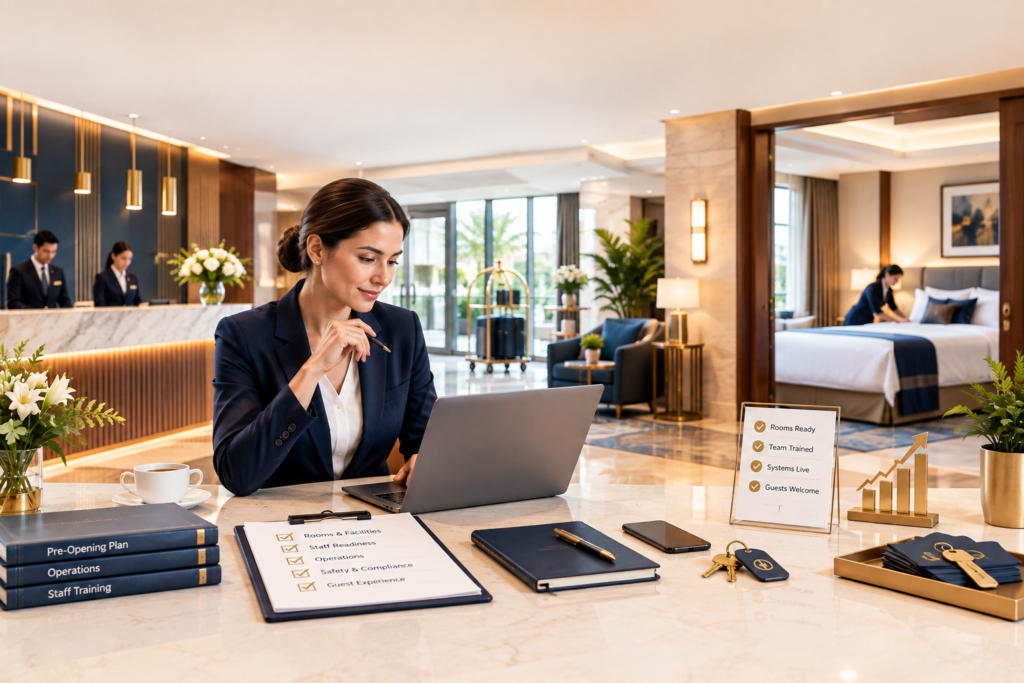
Opening a hotel is a major business project that requires detailed planning, strong coordination, proper budgeting, trained employees, reliable systems, and careful operational preparation. A hotel may have an excellent location, attractive rooms, modern facilities, and a strong business concept, but these factors alone do not guarantee a successful launch.
A Hotel Pre-Opening Checklist provides a structured framework for preparing every important part of the property before the first guest arrives. It helps hotel owners, investors, developers, general managers, and operational teams track important tasks, assign responsibilities, identify gaps, and make sure the hotel is ready to operate.
From construction and licensing to recruitment, staff training, technology, housekeeping, food and beverage, marketing, sales, safety, procurement, and guest experience, every department needs to be prepared before opening day.
A successful hotel opening is not simply about opening the doors on a particular date. It is about making sure that the property, people, systems, processes, and service standards are ready to deliver a consistent guest experience from day one.
This comprehensive
explains the major areas that hotel owners and management teams should review before launching a new hotel.
Why a Hotel Pre-Opening Checklist Is Important
A Hotel Pre-Opening Checklist involves hundreds of tasks, and many of them are connected.
For example, recruitment affects training. Training affects service quality. Technology affects reservations and billing. Procurement affects room readiness. Marketing affects initial bookings. Housekeeping affects guest satisfaction.
If one important area is not ready, it can affect several other departments.
A detailed Hotel Pre-Opening Checklist helps management organize these activities into manageable stages.
It can help the team:
- Track Hotel Pre-Opening Checklist activities
- Assign responsibilities
- Set deadlines
- Monitor expenses
- Identify operational gaps
- Coordinate departments
- Prepare employees
- Test technology
- Improve guest readiness
- Reduce opening-day problems
The checklist should be treated as a working document rather than a one-time list. Management should update it regularly as the opening date approaches.
1. Define the Hotel Concept
Before operational preparation begins, the hotel concept should be clearly established.
Management should determine:
- What type of hotel is being developed?
- Who are the target guests?
- What market segment will the hotel serve?
- What services will be provided?
- What makes the property different?
- What type of experience should guests receive?
- What price positioning will the hotel have?
The answers to these questions influence the hotel’s design, staffing, service standards, marketing, pricing, and operational structure.
A business hotel, for example, may require a different service model from a leisure resort.
A clear concept provides direction for the entire pre-opening process.
2. Create a Dedicated Pre-Opening Team
A successful hotel launch requires people who are responsible for coordinating the preparation process.
The pre-opening team may include:
- Hotel owner or investor
- General Manager
- Operations Manager
- Finance Manager
- Human Resources Manager
- Front Office Manager
- Housekeeping Manager
- Food and Beverage Manager
- Executive Chef
- Sales and Marketing Manager
- Revenue Manager
- Engineering Manager
- IT Manager
- Security Manager
- Procurement team
Each person should have clearly defined responsibilities.
Regular pre-opening meetings should be conducted to review progress and identify activities that are delayed.
3. Prepare a Detailed Opening Timeline
A hotel should have a clear opening schedule.
The timeline can be divided into:
- Six months before opening
- Three months before opening
- Two months before opening
- One month before opening
- Two weeks before opening
- Final week
- Opening day
- Post-opening review
Every major activity should have a target completion date.
For example:
Task: Staff recruitment
Responsible: HR Manager
Deadline: 60 days before opening
Status: In progress
This simple structure makes the Hotel Pre-Opening Checklist easier to manage.
4. Complete Construction and Property Readiness
The physical property must be substantially ready before operational preparation can be completed.
Management should inspect every major area.
Guest Rooms
Check:
- Beds
- Mattresses
- Furniture
- Curtains
- Flooring
- Lighting
- Bathrooms
- Fixtures
- Air conditioning
- Television
- Telephone
- Wi-Fi
- Electrical points
- Room amenities
Public Areas
Review:
- Lobby
- Reception
- Corridors
- Elevators
- Parking
- Restaurants
- Meeting rooms
- Recreation areas
- Outdoor spaces
Back-of-House Areas
Check:
- Staff areas
- Offices
- Storage
- Kitchens
- Laundry
- Receiving areas
- Engineering areas
Any unfinished work should be recorded and assigned to the responsible team.
5. Complete Licenses and Approvals
Legal and regulatory requirements should be addressed well before the planned opening.
Depending on the hotel, location, and facilities, requirements may include:
- Business registrations
- Fire and safety approvals
- Food-related licenses
- Health and sanitation requirements
- Building approvals
- Environmental requirements
- Local authority permissions
- Employment-related registrations
- Other applicable hospitality approvals
Requirements vary by location, so the hotel should verify its obligations with the appropriate authorities and qualified professionals.
Maintain a record showing:
Approval → Responsible Person → Application Date → Status → Expiry/Renewal
This should be an important part of the Hotel Pre-Opening Checklist.
6. Prepare the Pre-Opening Budget
Hotel Pre-Opening Checklist expenses can become significant if they are not controlled carefully.
The pre-opening budget may include:
- Recruitment
- Salaries
- Training
- Uniforms
- Technology
- Marketing
- Furniture
- Operating supplies
- Food inventory
- Housekeeping supplies
- Professional services
- Licenses
- Utilities
- Launch events
Management should distinguish between construction expenses, pre-opening expenses, and ongoing operating expenses.
Regular budget reviews can help identify unnecessary expenditure before opening.
7. Establish Departmental Budgets
Every department should understand its financial requirements.
Housekeeping
Budget for:
- Linen
- Towels
- Amenities
- Cleaning chemicals
- Cleaning equipment
Food and Beverage
Budget for:
- Food ingredients
- Beverages
- Crockery
- Cutlery
- Kitchen equipment
- Service equipment
Front Office
Budget for:
- Stationery
- Key cards
- Guest materials
- Office equipment
Engineering
Budget for:
- Tools
- Spare parts
- Maintenance materials
Departmental budgeting helps create financial accountability.
8. Recruit the Management Team
The management team should ideally be appointed early enough to participate in Hotel Pre-Opening Checklist
Important positions may include:
- General Manager
- Operations Manager
- Front Office Manager
- Executive Housekeeper
- Executive Chef
- Food and Beverage Manager
- Sales Manager
- Revenue Manager
- Finance Manager
- HR Manager
- Engineering Manager
Early recruitment allows managers to participate in SOP development, staff selection, supplier coordination, training, and operational planning.
9. Recruit Hotel Employees
After the management team is established, recruitment of operational employees can begin.
Positions may include:
- Front-office employees
- Housekeeping employees
- Restaurant staff
- Kitchen staff
- Engineering staff
- Security staff
- Sales employees
- Administrative employees
- Support staff
Recruitment should consider both technical skills and hospitality attitude.
Employees should understand that service quality begins with professional communication, teamwork, reliability, and attention to guest needs.
10. Create Job Descriptions
Every employee should have a clear understanding of their role.
Job descriptions should cover:
- Responsibilities
- Reporting structure
- Required skills
- Working hours
- Performance expectations
- Department responsibilities
Clear job descriptions help prevent confusion after opening.
11. Develop Hotel SOPs
Standard Operating Procedures are essential for consistent hotel operations.
The hotel should develop SOPs for:
- Reservations
- Check-in
- Checkout
- Room cleaning
- Room inspection
- Guest requests
- Complaint handling
- Lost and found
- Cash handling
- Restaurant service
- Food safety
- Maintenance
- Emergency situations
- Inventory
- Night audit
SOPs should be simple, practical, and easy for employees to follow.
12. Create Guest Service Standards
The hotel should clearly define the service experience it wants to provide.
Standards can cover:
- Guest greetings
- Telephone etiquette
- Email communication
- Check-in
- Check-out
- Complaint handling
- Guest requests
- Room presentation
- Restaurant service
- Personal grooming
These standards should be included in employee training.
13. Map the Complete Guest Journey
A hotel should review the guest experience from the first interaction to post-stay communication.
The journey includes:
Discover → Research → Book → Pre-Arrival → Arrival → Stay → Checkout → Post-Stay
Management should identify what each department needs to do at every stage.
For example, the sales team may create the initial expectation, reservations manages the booking, front office handles arrival, housekeeping maintains the room, food and beverage manages dining, and management oversees the overall experience.
14. Prepare the Front Office
The front office is one of the most visible hotel departments.
Before opening, check:
- Reception desk
- Computers
- Phones
- Key-card system
- Guest registration
- Cash procedures
- Reservation information
- Guest information materials
- Check-in procedures
- Checkout procedures
Employees should practice common guest situations before opening.
15. Configure the Reservation System
The reservation system should be fully prepared and tested.
Important information includes:
- Room categories
- Room numbers
- Rates
- Packages
- Availability
- Cancellation policies
- Taxes
- Payment methods
- Guest profiles
Test bookings should be made before launch to verify that the reservation process works correctly.
16. Configure the Property Management System
The PMS is an important operational system for many hotels.
Before opening, configure:
- Room inventory
- Room categories
- Rates
- Guest profiles
- Housekeeping status
- Billing
- Reports
- User permissions
- Payment settings
Employees should be trained through practical exercises.
17. Prepare the Hotel Website
The hotel website should be ready before launch.
Important pages may include:
- Home
- Rooms
- Dining
- Facilities
- Location
- About
- Contact
- Offers
- Events
- Booking
All information should be accurate.
The website should also work properly on smartphones, tablets, and desktop computers.
18. Prepare Online Booking Channels
Hotels may use multiple booking channels.
These can include:
- Hotel website
- Online travel agencies
- Travel agencies
- Corporate booking channels
- Other distribution platforms
Rates, availability, room descriptions, policies, and photographs should be checked carefully.
Incorrect information can create booking problems and guest dissatisfaction.
19. Create the Hotel Marketing Plan
Marketing should begin before opening day.
The pre-opening marketing plan may include:
- Search engine optimization
- Social media
- Digital advertising
- Local marketing
- Corporate sales
- Travel partnerships
- Email marketing
- Public relations
- Launch campaigns
The objective is to create awareness before the hotel officially opens.
20. Prepare Hotel Photography and Video
Professional visual content is important for hotel marketing.
Photographs should cover:
- Exterior
- Lobby
- Guest rooms
- Bathrooms
- Restaurant
- Food
- Facilities
- Meeting spaces
- Unique features
Videos can include:
- Room tours
- Hotel tours
- Restaurant experiences
- Destination guides
- Facility demonstrations
All visual content should accurately represent the final property.
21. Develop Sales Materials
The sales team should have professional materials ready before contacting customers.
These may include:
- Hotel brochure
- Room information
- Corporate rate sheets
- Event packages
- Wedding packages
- Meeting room details
- Restaurant information
- Digital presentation
- Sales proposal
This helps the sales team communicate the hotel’s offering consistently.
22. Build Corporate Partnerships
Corporate business can be an important source of hotel demand.
Potential corporate partners include:
- Local companies
- Regional businesses
- Corporate travel managers
- Business associations
- Event organizations
The hotel can present suitable accommodation, meeting, dining, and corporate packages.
23. Develop Travel Trade Partnerships
Travel agencies and tour operators can help introduce a new hotel to their customers.
The sales team can build relationships with:
- Travel agencies
- Tour operators
- Destination management companies
- Wedding planners
- Event planners
These relationships should be established before the launch whenever possible.
24. Prepare Housekeeping Operations
Housekeeping has a direct influence on guest satisfaction.
Before opening, prepare:
- Cleaning procedures
- Room inspection standards
- Linen management
- Laundry procedures
- Guest amenities
- Cleaning chemicals
- Equipment
- Uniforms
- Storage systems
- Lost-and-found procedures
Every room should be inspected before it becomes available for sale.
25. Complete Guest Room Inspections
Every room should undergo a detailed inspection.
Check:
- Bed
- Linen
- Pillows
- Towels
- Bathroom
- Toiletries
- Lighting
- Air conditioning
- Television
- Telephone
- Wi-Fi
- Curtains
- Furniture
- Electrical points
- Safety equipment
- Room information
A room should meet the hotel’s defined standards before being released for sale.
26. Prepare Food and Beverage Operations
Hotels with restaurants need detailed preparation.
The team should finalize:
- Menus
- Recipes
- Kitchen procedures
- Food suppliers
- Food storage
- Hygiene procedures
- Restaurant layout
- Service standards
- POS system
- Inventory controls
The restaurant should be tested before the hotel opens to the public.
27. Conduct Food and Beverage Trials
Trial operations can reveal problems before opening.
Test:
- Food preparation
- Food quality
- Presentation
- Table setup
- Service timing
- Kitchen communication
- Billing
- Menu availability
Employee feedback should be collected during these trials.
28. Select and Test Suppliers
Hotels depend on reliable suppliers.
Suppliers may provide:
- Food
- Beverages
- Linen
- Amenities
- Cleaning products
- Office supplies
- Engineering materials
- Guest supplies
Before opening, management should confirm:
- Quality
- Pricing
- Delivery schedules
- Payment terms
- Minimum order quantities
- Backup suppliers
29. Build Opening Inventory
A new hotel requires sufficient operating inventory.
This may include:
- Linen
- Towels
- Guest amenities
- Cleaning products
- Food
- Beverages
- Stationery
- Engineering spare parts
- Uniforms
- Office supplies
Inventory should be checked before the opening date.
30. Prepare Hotel Uniforms
Employee uniforms should be finalized before launch.
Check:
- Design
- Size
- Comfort
- Quality
- Department identification
- Shoes
- Name badges
Employees should have sufficient time for fittings and alterations.
31. Establish Grooming Standards
Professional appearance contributes to the hotel’s overall presentation.
Standards may cover:
- Hair
- Uniform
- Shoes
- Personal hygiene
- Name badges
- Accessories
- Professional appearance
These standards should be explained during employee orientation.
32. Conduct Staff Training
Training should begin well before opening.
Employees should receive training in:
- Hotel orientation
- Brand standards
- SOPs
- Guest communication
- Complaint handling
- Technology
- Safety
- Emergency procedures
- Product knowledge
- Cross-department communication
Training should include practical exercises.
33. Conduct Cross-Department Training
Hotel departments cannot operate independently.
For example:
Front office needs updated room status from housekeeping.
Housekeeping needs information about arrivals and departures.
Food and beverage needs information about groups and events.
Engineering needs to respond to maintenance requests from multiple departments.
Cross-training helps employees understand how their work affects the complete guest journey.
34. Test Hotel Technology
All technology should be tested before launch.
This may include:
- PMS
- POS
- Wi-Fi
- Telephones
- CCTV
- Key-card systems
- Accounting software
- Booking engine
- Digital payment systems
- Guest communication systems
Testing should include realistic operational scenarios.
35. Prepare Financial Systems
The finance department should be operational before the first transaction.
Prepare:
- Accounting software
- Payment systems
- Cash procedures
- Banking
- Invoicing
- Purchasing
- Payroll
- Expense controls
- Financial reporting
Financial responsibilities should be clearly assigned.
36. Prepare Revenue Management
Revenue management should begin before opening.
The hotel should establish:
- Room categories
- Rate plans
- Seasonal rates
- Corporate rates
- Packages
- Promotional rates
- Distribution strategy
Pricing should be reviewed regularly after opening based on actual market conditions and performance.
37. Prepare Safety and Security
Safety should be integrated into the Hotel Pre-Opening Checklist from the beginning.
Review:
- Fire alarms
- Emergency exits
- Fire equipment
- Emergency lighting
- Evacuation routes
- CCTV
- Access control
- Security procedures
- Incident reporting
- Emergency communication
Employees should understand their responsibilities during emergencies.
38. Conduct Emergency Drills
Before opening, employees should understand emergency procedures.
Training and drills can cover:
- Fire evacuation
- Emergency communication
- Guest assistance
- Security incidents
- First-aid response
- Evacuation routes
The exact requirements should follow applicable local regulations and professional safety guidance.
39. Conduct a Soft Opening
A soft opening provides an opportunity to test operations under realistic conditions.
The hotel can evaluate:
- Check-in
- Housekeeping
- Restaurant service
- Room service
- Guest requests
- Maintenance
- Billing
- Checkout
A soft opening can reveal operational issues that may not appear during departmental testing.
40. Conduct a Mock Guest Journey
A mock guest experience is an effective final test.
A team member can act as a guest and complete:
Reservation → Arrival → Check-in → Room → Dining → Guest Request → Checkout
The team should record every issue.
For example:
- Was the room ready?
- Was check-in fast?
- Did the key work?
- Was Wi-Fi accessible?
- Was the restaurant ready?
- Did staff respond quickly?
- Was the final bill accurate?
The findings can be added to the final Hotel Pre-Opening Checklist.
41. Create a Pre-Opening Punch List
A punch list identifies unfinished or defective items.
It may include:
- Construction defects
- Missing furniture
- Maintenance issues
- Technology problems
- Signage
- Cleaning
- Safety concerns
- Inventory shortages
- Room defects
Each item should have:
Issue → Responsible Person → Deadline → Status
The list should be reviewed frequently until all critical issues are resolved.
42. Conduct the Final Hotel Readiness Audit
The final readiness audit should cover the complete property.
Property
Is the building ready?
People
Are employees recruited and trained?
Processes
Are SOPs implemented?
Technology
Are systems tested?
Finance
Are payment and accounting systems ready?
Sales
Are sales channels active?
Marketing
Is the hotel visible online?
Inventory
Are essential supplies available?
Safety
Are safety systems operational?
Guest Experience
Can the hotel deliver the promised service?
This final review is one of the most important stages of the Hotel Pre-Opening Checklist.
43. Hotel Pre-Opening Checklist: 30 Days Before Launch
The final 30 days require particularly close coordination.
30 Days Before Opening
- Complete major property work
- Finalize recruitment
- Confirm suppliers
- Configure hotel systems
- Begin intensive staff training
- Finalize marketing campaigns
- Inspect guest rooms
- Complete operational SOPs
21 Days Before Opening
- Test technology
- Test reservations
- Finalize menus
- Check inventory
- Conduct staff training
- Begin sales activities
- Review guest journey
14 Days Before Opening
- Conduct mock operations
- Inspect rooms
- Test check-in
- Test checkout
- Test restaurant operations
- Review safety procedures
- Resolve outstanding issues
7 Days Before Opening
- Complete final property inspection
- Confirm staff schedules
- Check all rooms
- Verify inventory
- Test booking channels
- Review opening reservations
- Conduct final staff briefing
1–2 Days Before Opening
- Complete final cleaning
- Check guest rooms
- Confirm system availability
- Review reservations
- Confirm staffing
- Test communication channels
- Conduct final management walkthrough
44. Common Hotel Pre-Opening Mistakes
Even well-planned projects can face problems if preparation is rushed.
Starting Recruitment Too Late
Employees need sufficient time for orientation and training.
Ignoring SOPs
Without clear procedures, employees may provide inconsistent service.
Opening Without Testing Systems
Technology problems can affect reservations, billing, room allocation, and guest communication.
Starting Marketing Too Late
A new hotel needs time to create awareness and generate demand.
Underestimating Inventory
Missing basic operating supplies can affect daily operations.
Ignoring Cross-Department Communication
Poor communication can create delays and guest complaints.
Skipping a Soft Opening
A controlled opening can reveal operational problems before full-scale operations.
Focusing Only on the Building
A hotel is not simply a physical property. People, processes, technology, service, and guest experience are equally important.
45. How to Improve Hotel Pre-Opening Planning
The Hotel Pre-Opening Checklist should be reviewed regularly rather than created once and forgotten.
Management can improve the process by:
Assigning One Person to Track Progress
A dedicated coordinator can monitor deadlines and responsibilities.
Using Departmental Checklists
Each department should have its own detailed list.
Holding Weekly Meetings
Regular meetings help identify delays early.
Tracking Critical Tasks
Tasks affecting safety, licensing, technology, staffing, and guest readiness should receive special attention.
Using Clear Status Indicators
For example:
- Not Started
- In Progress
- Completed
- Delayed
- Requires Review
Conducting Multiple Inspections
One final inspection may not be enough. Property and operational checks should happen throughout the preparation period.
46. Hospitality Consulting for Hotel Pre-Opening
Opening a hotel involves multiple areas of expertise.
Professional hospitality consulting can support owners and management teams with:
- Pre-opening planning
- Hotel operations
- SOP development
- Staff recruitment
- Staff training
- Revenue management
- Sales and marketing
- Vendor coordination
- Guest experience
- Technology implementation
- Soft opening
- Operational audits
A consultant can also help management identify gaps between the planned hotel concept and actual operational readiness.
This can be particularly useful for investors and owners who have limited experience managing hotel operations.
47. Final Hotel Pre-Opening Checklist
Before the hotel officially opens, management should review the following:
Property
- Is the hotel physically ready?
- Are guest rooms complete?
- Are public areas ready?
- Are facilities operational?
Legal
- Are required approvals completed?
- Are relevant licenses available?
- Are safety requirements addressed?
People
- Is the management team in place?
- Are employees recruited?
- Has training been completed?
- Are uniforms ready?
Operations
- Are SOPs complete?
- Are departments coordinated?
- Are guest service standards defined?
Technology
- Is the PMS ready?
- Is the POS working?
- Is Wi-Fi tested?
- Is the booking engine operational?
- Are payment systems working?
Housekeeping
- Are rooms inspected?
- Is linen available?
- Are amenities available?
- Are cleaning procedures ready?
Food and Beverage
- Are menus finalized?
- Are suppliers confirmed?
- Is inventory available?
- Has restaurant service been tested?
Sales and Marketing
- Is the website ready?
- Are online booking channels active?
- Is social media prepared?
- Are sales materials ready?
- Are partnerships established?
Finance
- Are accounting systems ready?
- Are payment processes tested?
- Is the opening budget being monitored?
Safety
- Are emergency exits clear?
- Are fire systems tested?
- Is security operational?
- Are employees trained for emergencies?
Guest Experience
- Is the complete guest journey tested?
- Are complaint procedures ready?
- Can the hotel deliver its promised experience?
48. Hotel Opening Day Preparation
The opening day should have a clear operational plan.
Management should confirm:
- Staff schedules
- Expected arrivals
- Room availability
- VIP or special requests
- Restaurant reservations
- Maintenance availability
- Security coverage
- Emergency contacts
- Management presence
- Communication procedures
A management team should closely monitor operations during the first days of opening.
Problems should be documented and addressed quickly.
49. Post-Opening Review
The Hotel Pre-Opening Checklist does not become irrelevant once the hotel opens.
After launch, management should review what happened during the first days and weeks.
Analyze:
- Guest feedback
- Complaints
- Check-in times
- Room readiness
- Housekeeping performance
- Restaurant operations
- Technology issues
- Staff performance
- Maintenance issues
- Booking patterns
- Revenue performance
The first few weeks can provide valuable information for improving hotel operations.
50. The Importance of Continuous Improvement
A successful hotel opening is only the beginning.
After launch, management should continue improving:
- Service quality
- Guest experience
- Staff training
- Operational efficiency
- Revenue performance
- Marketing
- Cost management
- Technology
- Guest communication
The hotel should use actual guest feedback and operational data to identify areas for improvement.
A strong opening creates the foundation, but consistent management determines how that foundation develops over time.
Conclusion
A complete Hotel Pre-Opening Checklist provides hotel owners, investors, developers, and management teams with a practical framework for preparing a new property for launch.
From defining the Hotel Pre-Opening Checklist concept and completing construction to obtaining approvals, recruiting employees, developing SOPs, configuring technology, preparing guest rooms, setting up food and beverage operations, establishing suppliers, creating marketing campaigns, training staff, testing systems, and conducting a soft opening, every stage requires careful attention.
The most important objective is not simply to open the hotel on schedule. The objective is to open a property that is operationally ready, financially prepared, properly staffed, technologically functional, and capable of delivering the intended guest experience.
A well-managed Hotel Pre-Opening Checklist can help identify potential problems before they affect guests and can improve coordination between departments.
Hotel owners should also remember that pre-opening preparation does not end on opening day. The first weeks and months provide valuable information that can be used to improve service, operations, guest satisfaction, and business performance.
By combining detailed planning, professional management, employee training, operational testing, effective marketing, and continuous improvement, a new hotel can establish a strong foundation for its future.
A successful hotel launch begins long before the first guest walks through the door. The better the preparation, the more organized the opening and the stronger the foundation for long-term hotel operations.