1. Monitor and Analyze Every Major Expense
The first step in hotel cost control is understanding where the money is going.
Hotel owners and managers should regularly review expenses by department rather than looking only at the total monthly expenditure.
For example, expenses can be divided into:
- Front office
- Housekeeping
- Food and beverage
- Kitchen
- Maintenance
- Sales and marketing
- Administration
- Human resources
- Utilities
- Purchasing
This makes it easier to identify unusual increases.
Suppose housekeeping expenses increased by 15% compared with the previous month. Management can investigate whether the increase was caused by higher occupancy, increased laundry costs, excessive supply usage, supplier price changes, or wastage.
Without department-level monitoring, such problems can remain hidden.
Create a monthly expense review
A simple monthly review can compare:
Budget → Actual Expense → Difference → Reason → Corrective Action
This creates accountability and allows managers to identify problems before they become larger financial issues.
2. Improve Hotel Staff Scheduling
Labor is one of the most important operating expenses for many hotels.
However, reducing staff numbers is not always the correct solution.
Poor scheduling can create unnecessary labor costs while also creating service problems.
For example, a hotel may schedule too many employees during periods of low occupancy and too few employees during busy periods.
A better approach is to match staffing levels with actual operational demand.
Managers can consider:
- Occupancy forecasts
- Expected arrivals and departures
- Group bookings
- Restaurant demand
- Events
- Peak check-in periods
- Peak breakfast periods
- Seasonal demand
Proper staff scheduling helps ensure that the hotel has the right number of employees at the right time.
It can also reduce unnecessary overtime.
Cross-training employees
Cross-training can provide additional flexibility.
For example, employees can be trained to understand responsibilities in related departments where appropriate.
This does not mean asking employees to perform every possible job. Instead, it gives management greater flexibility when demand changes or unexpected staff shortages occur.
The result can be better productivity without compromising service quality.
3. Reduce Energy and Utility Costs
Energy consumption can represent a significant operating expense for hotels.
Rooms, restaurants, kitchens, laundry facilities, offices, common areas, water heating systems, air conditioning, and other equipment can consume large amounts of electricity and water.
Hotels can introduce practical energy management systems such as:
- LED lighting
- Occupancy-based lighting
- Efficient air-conditioning systems
- Regular HVAC maintenance
- Temperature controls
- Energy-efficient appliances
- Water-saving fixtures
- Preventive equipment maintenance
- Monitoring of electricity consumption
Guest rooms can also be monitored to reduce unnecessary energy consumption when rooms are unoccupied.
However, energy-saving measures should be implemented carefully.
Guest comfort should remain a priority.
The goal is not to make the hotel uncomfortable. The goal is to eliminate unnecessary energy consumption.
4. Improve Inventory Management
Poor inventory management can quietly increase hotel operating expenses.
Hotels purchase large quantities of products, including:
- Housekeeping supplies
- Toiletries
- Linen
- Food ingredients
- Beverages
- Cleaning chemicals
- Office supplies
- Maintenance materials
- Guest amenities
If inventory is not properly monitored, several problems can occur.
These may include:
- Overstocking
- Expired products
- Product damage
- Theft
- Duplicate purchasing
- Emergency purchasing
- Unnecessary stock accumulation
Hotels should establish minimum and maximum stock levels for important items.
A regular inventory count can help management identify differences between:
Opening Stock + Purchases − Consumption = Expected Closing Stock
If actual stock is significantly different from expected stock, management should investigate the reason.
Good inventory control can reduce waste while ensuring that essential items remain available.
5. Control Food and Beverage Costs
Food and beverage operations can generate significant revenue for hotels, but they can also create substantial expenses when poorly managed.
Common causes of high F&B costs include:
- Food waste
- Over-purchasing
- Poor portion control
- Spoilage
- Incorrect storage
- Excessive complimentary items
- Theft
- Poor menu planning
- Inaccurate inventory records
Hotels can improve F&B cost control through:
Standard recipes
Standard recipes help maintain consistent quantities and costs.
Portion control
Consistent portions make food costs easier to predict.
Proper storage
Correct storage temperatures and procedures can reduce spoilage.
Menu engineering
Hotels can evaluate which menu items generate strong margins and which items may need adjustment.
Regular stocktaking
Frequent inventory checks help identify discrepancies and reduce unnecessary purchasing.
The objective should be to control food costs without reducing food quality.
6. Negotiate Better Supplier Agreements
Purchasing decisions have a direct impact on hotel operating expenses.
Hotels often purchase products from multiple suppliers, which means there may be opportunities to negotiate better commercial terms.
Management can review:
- Product prices
- Minimum order quantities
- Delivery charges
- Payment terms
- Discounts
- Seasonal pricing
- Contract terms
- Product quality
- Delivery reliability
However, the cheapest supplier is not always the best supplier.
A lower purchase price may come with lower quality, unreliable delivery, or inconsistent products.
Hotels should evaluate suppliers based on price, quality, consistency, reliability, and service.
Long-term supplier relationships can also provide opportunities for better pricing and more predictable purchasing.
7. Implement Preventive Maintenance
Unexpected equipment failures can become expensive.
A broken air-conditioning system, refrigerator, boiler, water pump, kitchen appliance, elevator component, or other critical equipment can lead to:
- Emergency repair costs
- Replacement costs
- Room downtime
- Guest complaints
- Operational disruption
- Revenue loss
Preventive maintenance helps identify potential problems before they become major failures.
Hotels should maintain schedules for important equipment and systems.
For example:
- HVAC servicing
- Plumbing inspections
- Electrical inspections
- Kitchen equipment maintenance
- Generator maintenance
- Fire safety equipment checks
- Water systems
- Laundry equipment
Preventive maintenance may require regular spending, but it can reduce the likelihood of expensive emergency repairs.
8. Reduce Housekeeping and Laundry Waste
Housekeeping is another area where small inefficiencies can create significant recurring expenses.
Hotels regularly use:
- Cleaning chemicals
- Toilet amenities
- Linen
- Towels
- Laundry services
- Garbage bags
- Guest supplies
- Cleaning equipment
Hotels can improve housekeeping hotel cost control by standardizing how supplies are used.
For example, employees can be trained on the appropriate quantity of cleaning chemicals rather than using excessive amounts.
Linen and towel management should also be monitored.
Hotels can establish clear procedures for:
- Linen collection
- Linen storage
- Laundry
- Damaged linen
- Lost linen
- Replacement
- Room usage
Training is particularly important.
A well-trained housekeeping team can maintain cleanliness standards while using resources efficiently.
9. Use Technology to Improve Operational Efficiency
Technology can help hotels reduce repetitive administrative work and improve visibility into expenses.
Depending on the property’s size and requirements, technology can support:
- Inventory management
- Accounting
- Purchasing
- Staff scheduling
- Room management
- Energy monitoring
- Revenue management
- Guest communication
- Reporting
- Maintenance tracking
The important point is that technology should solve an actual operational problem.
Hotels do not necessarily need expensive software for every department.
A simple system that provides accurate information and improves accountability can be more useful than a complicated system that employees do not use properly.
Technology should therefore be selected based on the hotel’s operational requirements, budget, and size.
10. Conduct Regular Hotel Operational Audits
One of the most effective ways to maintain hotel cost control is to regularly review how the property is operating.
An operational audit can examine:
- Departmental expenses
- Purchasing procedures
- Inventory
- Staff productivity
- Housekeeping
- Food and beverage
- Maintenance
- Utilities
- SOP compliance
- Guest service
- Financial procedures
An audit can reveal problems that daily management may overlook.
For example, a hotel may discover that it is repeatedly purchasing products that are already available in storage.
Another hotel may discover that a particular process requires unnecessary manual work.
The purpose of an audit is not simply to find mistakes.
It is to identify opportunities to improve efficiency, accountability, and profitability.
Regular audits can also help ensure that hotel SOPs and financial controls are actually being followed.
Hotel Cost Control Should Not Mean Cutting Service Quality
One of the biggest mistakes in hotel cost reduction is treating every expense as something that should be eliminated.
This approach can create long-term problems.
For example, reducing housekeeping staff too aggressively may result in:
- Slower room turnaround
- Poor room cleanliness
- Guest complaints
- Lower online ratings
Similarly, reducing staff training may reduce short-term expenses but can affect service quality over time.
Reducing maintenance spending may save money today but create expensive equipment failures later.
Therefore, hotel cost control should focus on removing waste rather than removing value.
A better question is:
“How can we achieve the same or better result with fewer wasted resources?”
That is the foundation of sustainable cost management.
Important Hotel Cost Control Metrics
Hotel managers should not rely only on total expenses.
Several metrics can provide a clearer picture of financial performance.
Labor Cost
Track labor expenses in relation to hotel revenue and operational demand.
Food Cost Percentage
Useful for understanding whether food purchasing and menu pricing are being managed effectively.
Utility Cost
Monitoring electricity, water, gas, and other utilities can help identify unusual increases.
Cost Per Occupied Room
This can help management understand how much it costs to operate a room that is actually occupied.
Departmental Expenses
Review expenses separately for housekeeping, F&B, maintenance, front office, and other departments.
Budget vs Actual
Compare planned expenses against actual spending.
These metrics help management move from simply recording expenses to actively managing them.
Create a Hotel Cost Control System
For long-term results, cost control should become part of the hotel’s regular management process.
A simple system can follow this cycle:
1. Set the Budget
Establish realistic departmental budgets.
2. Track Actual Expenses
Record spending accurately.
3. Compare Results
Compare actual expenses with the budget.
4. Identify Variations
Find significant differences.
5. Investigate the Reason
Determine why the expense changed.
6. Take Corrective Action
Implement an appropriate solution.
7. Measure the Result
Check whether the change actually improved performance.
This creates a continuous improvement process rather than a one-time cost-cutting exercise.
How Hotel Cost Control Improves Profitability
Hotel profitability depends on both revenue generation and expense management.
Consider two hotels with similar occupancy.
Hotel A generates higher revenue but also has poor purchasing controls, excessive food waste, inefficient staffing, and high utility consumption.
Hotel B has similar revenue but better operational systems and tighter cost control.
Hotel B may ultimately generate stronger profits despite having similar revenue.
This is why hotel owners should look beyond occupancy and room revenue.
Important questions include:
- How much does each occupied room cost?
- Which departments are exceeding their budgets?
- Where is inventory being wasted?
- Are staffing levels aligned with demand?
- Are suppliers offering competitive terms?
- Are utility expenses increasing?
- Are maintenance costs being controlled?
- Are operational SOPs being followed?
Answering these questions can help management make better financial decisions.
The Role of Hotel Management in Cost Control
Effective hotel cost control requires cooperation across the entire hotel.
Finance teams monitor financial information.
Operations teams manage daily processes.
Housekeeping controls supplies and linen.
Kitchen teams manage food usage.
Maintenance teams manage equipment and utilities.
Human resources manages staffing and training.
Senior management brings all of these areas together.
This means hotel cost control is not only the responsibility of the accountant or finance department.
Every department contributes to the hotel’s financial performance.
When employees understand how their daily decisions affect costs, cost control becomes part of the hotel’s culture.
When Should a Hotel Consider Professional Cost Control Support?
Some hotel owners may find it difficult to identify operational inefficiencies from inside the business.
An independent hospitality consultant can review the property from an operational and financial perspective.
Professional support can be particularly useful when:
- Operating costs are increasing
- Profit margins are declining
- Occupancy is reasonable but profitability remains low
- Food costs are too high
- Labor costs are difficult to control
- Inventory discrepancies occur
- Guest satisfaction is declining
- Hotel departments are not working efficiently
- SOPs are missing or outdated
- The hotel is preparing for restructuring
- Management wants an independent operational audit
A professional assessment can help identify where the hotel is losing money and which improvements are likely to have the greatest impact.
Korahsson provides hospitality services covering hotel management, financial planning, audits, staff training, housekeeping solutions, restaurant management, and consultancy, making cost and operational efficiency a natural part of its broader hospitality approach.
Final Thoughts
Hotel cost control is not about spending as little money as possible. It is about using money, people, time, equipment, and resources efficiently.
The most effective hotels continuously monitor their expenses and look for ways to improve operational efficiency without compromising guest experience.
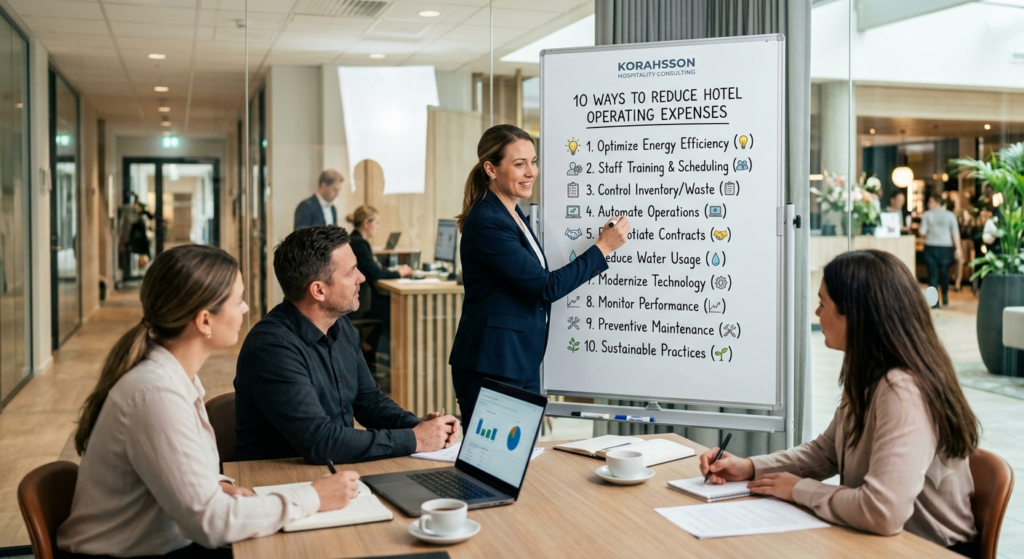
The 10 strategies discussed in this guide include:
- Monitor and analyze major expenses
- Improve staff scheduling
- Reduce unnecessary energy consumption
- Improve inventory management
- Control food and beverage costs
- Negotiate better supplier agreements
- Implement preventive maintenance
- Reduce housekeeping and laundry waste
- Use technology to improve efficiency
- Conduct regular hotel operational audits
When these practices become part of everyday hotel management, they can help reduce unnecessary operating expenses, improve efficiency, protect service quality, and support stronger long-term profitability.
For hotel owners, the goal should not simply be to reduce costs—it should be to build a more efficient and financially sustainable hotel operation.
FAQ
What is hotel cost control?
Hotel cost control is the process of monitoring and managing hotel expenses to reduce unnecessary spending, improve operational efficiency, and maintain profitability without compromising guest service.
How can hotels reduce operating expenses?
Hotels can reduce operating expenses by improving staff scheduling, controlling inventory, reducing energy waste, managing food costs, negotiating with suppliers, implementing preventive maintenance, and conducting regular operational audits.
What is the biggest expense in a hotel?
Labor is often one of the largest hotel operating expenses, although the exact cost structure varies depending on the hotel’s size, category, location, services, and business model.
How can hotels reduce food costs?
Hotels can reduce food costs through accurate inventory management, standard recipes, portion control, proper storage, waste monitoring, supplier management, and regular food-cost analysis.
Does cost cutting affect guest satisfaction?
It can if cost reduction is done incorrectly. Cutting essential staff, maintenance, cleaning standards, or guest services can negatively affect the guest experience. Effective cost control should focus on reducing waste and improving efficiency rather than simply cutting essential services.
How often should a hotel review its expenses?
Hotels should monitor important expenses regularly and conduct a more detailed departmental financial review at least monthly. Larger or more complex properties may benefit from more frequent monitoring of high-value expense categories.
How can a hotel improve profitability without increasing room rates?
Hotels can improve profitability by controlling unnecessary expenses, reducing waste, improving staff productivity, optimizing inventory, increasing direct bookings, improving food and beverage performance, and making better use of available resources.